
Marriage ceremonies will never be the same again in Jammu and Kashmir. The government has brought nuptials of all religious hues under the Essential Commodities Act to prevent wastage of food at wedding feasts.
The government has agreed to remove coal from the list of essential commodities in the Essential Commodities Act, the Lok Sabha was informed on Thursday.

Though the Centre has asked states to crack down on speculators and hoarders to check spiraling prise of onion, state governments could do little as the commodity is not under the purview of the Essential Commodities Act, a senior government official said.

These items will remain under essential commodities segment till June-end, a move aimed at ensuring availability at reasonable prices and cracking down on hoarders/black marketeers.
A year after it declassified steel and its products from the list of essential commodities, the government is preparing to bring it back under the ambit of the Essential Commodities Act, 1955. The Act gives power to the government to control production, supply and distribution of essential commodities at a fair price.

On March 13, the Union consumer affairs ministry had declared face masks and hand sanitisers as essential commodities for 100 days to boost supply and prevent hoarding of these items in its fight to check the spread of coronavirus.
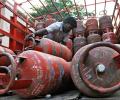
The District Supply Department in Nanded conducted a raid on a residence, uncovering an illegal stockpile of LPG cylinders and initiating legal action against the individual involved.

Police in Hoshiarpur have arrested two men for allegedly stealing LPG from tankers and illegally selling it. The suspects were caught in Dasuya during a raid where they were transferring LPG into domestic cylinders.
Police in Thane district seized 84 illegally stored LPG cylinders worth Rs 2.22 lakh from a private premises in Bhiwandi, leading to a case against three individuals under the Essential Commodities Act. The raid comes amid increased vigilance to prevent hoarding and black marketing of domestic gas cylinders.

Police in Maharashtra's Beed district have invoked the Maharashtra Prevention of Dangerous Activities (MPDA) Act against five history-sheeters to prevent them from committing more offences.

The Indian government has restricted industrial, commercial, and institutional users from purchasing petrol and diesel from retail petrol pumps, directing them to bulk sale points instead. This move, which can last up to 90 days, aims to address abnormal demand growth and prevent localised shortages caused by a significant price difference between retail and bulk fuel prices.

The Indian government has reassured citizens that the country has sufficient reserves of petrol, diesel, and LPG, and that refineries are operating at high capacity despite global supply chain disruptions. They have urged citizens to avoid panic buying and hoarding.
A joint operation by police and revenue officials in Beed, Maharashtra, resulted in the seizure of 29 illegally stored LPG cylinders intended for black marketing, amidst concerns of potential shortages due to the West Asia crisis.

The Indian government has issued a stern warning to industrial users who are reportedly procuring cheaper retail fuel instead of industrial-grade fuel, leading to significant losses for state-run oil marketing companies (OMCs) and potential local shortages. This diversion, driven by a substantial price difference between retail and bulk diesel, is adversely impacting OMCs, which are absorbing daily losses of approximately 550 crore to keep retail prices stable.
Delhi Police busted an illegal LPG cylinder storage unit in Rajpur Khurd, arresting two individuals and seizing 223 cylinders. The facility was operating without a valid license, posing a safety risk to nearby residents.
Delhi Police arrested three men in Mahipalpur for illegally hoarding LPG cylinders and selling them at inflated prices. The raid uncovered a large number of domestic and commercial cylinders, along with refilling equipment.
Delhi Police arrested three individuals in Shaheen Bagh for allegedly hoarding and black marketing domestic LPG cylinders. The accused were caught after a raid and found to be illegally transferring subsidised gas for profit.
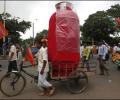
Delhi Police arrested a gas agency owner for allegedly hoarding and black marketing LPG cylinders, seizing 459 cylinders in a raid.
An FIR has been filed against a gas agency in Lucknow for allegedly illegally storing domestic LPG cylinders and attempting to sell them on the black market.

Tamil Nadu Petroleum Dealers' Association urged people not to panic-buy petrol or diesel, stating that 14 terminals in Tamil Nadu have enough stock to replenish 7,000-plus retail outlets as per their demand.
Delhi Police have dismantled multiple illegal LPG storage and refilling units across the city, seizing a large number of cylinders and apprehending several individuals involved in the illicit operations.
Delhi Police have registered multiple FIRs and seized hundreds of LPG cylinders in a crackdown on illegal storage, refilling, and black marketing operations amid concerns of potential supply shortages.
Delhi Police have dismantled an illegal operation involving the storage of over 600 LPG cylinders and arrested an individual for illegally refilling gas cylinders, highlighting concerns over safety and black market activities.

The government on Thursday restored liquefied petroleum gas (LPG) supplies to commercial consumers such as hotels, restaurants and other businesses to pre-crisis levels, and lifted sector-specific restrictions imposed during the recent West Asia conflict, in a sign that energy supply concerns are easing as global markets stabilise.
Authorities in Gurugram, India, have cracked down on the black marketing of domestic LPG cylinders, seizing 32 cylinders and detaining one individual involved in illegally siphoning gas.
Delhi Police busted two illegal LPG hoarding and refilling rackets, seizing 125 cylinders and arresting three delivery agents.

Commodity markets, especially the metals, are among the most volatile segments of the Indian financial ecosystem. To traders involved in commodity trading, it is not only helpful to keep track of the daily price changes but also necessary to make informed trading decisions. Commodities like gold, silver, copper, and aluminium react to many different factors, which makes it imperative for commodity traders to watch out for metal prices every day.

The government is identifying households with both liquefied petroleum gas (LPG) and piped natural gas (PNG) connections to enforce a ban on dual ownership, aiming to curb misuse and better target subsidies amid global energy supply disruptions.

Police in Ballia, Uttar Pradesh, have registered a case against a petrol pump manager for allegedly denying fuel to a private ambulance, resulting in the death of a 50-year-old patient.

Prime Minister Narendra Modi convened the Cabinet Committee on Security to address the impact of the West Asia conflict on Indian citizens, focusing on safeguarding them from the conflict's effects and ensuring the smooth flow of essential supplies.
A 28-year-old man was arrested in Delhi for illegally selling LPG cylinders, leading to the recovery of 62 cylinders and a vehicle. The accused was selling cylinders without authorisation and at inflated prices.

The ongoing Iran-US conflict is casting a shadow over global cricket, potentially disrupting the IPL 2026 due to travel disruptions and logistical challenges.

'If the war continue for a longer period of time, it is just a matter of time before the government will pass on some of the price increases.'

The National Pharmaceutical Pricing Authority will monitor how companies are increasing prices of non-scheduled drugs.

India imports nearly 60 percent of its LPG, with most cargo previously coming through the Strait of Hormuz, now closed for commercial shipping.

The Board of Control for Cricket in India (BCCI) today announced the schedule for the first phase of the Indian Premier League (IPL) 2026, to be played from March 28 to April 12, 2026.

The government has mandated that cooking gas LPG supply to households will be discontinued if consumers fail to switch to piped natural gas where such connectivity is available, under a new order aimed at accelerating gas network expansion and reducing reliance on a single fuel.

Companies are already diversifying sourcing, raising prices, and reworking operating models as the disruption drags on.

Insights from behavioural economics suggest that an ambitious nudge can be effective if three conditions are met, points out Ram Singh Insights from behavioural economics suggest that an ambitious nudge can be effective if three conditions are met, points out Ram Singh, director, Delhi School of Economics.

India restricts subsidised LPG connections for households with piped natural gas (PNG) to ensure equitable distribution and address global energy supply concerns, pushing for faster PNG adoption.
